Permaculture Seminar in Chicago


Bill Wilson of Midwest Permaculture says Permaculture is a creative and artful way of living, where people and nature are both preserved and enhanced by thoughtful planning, the careful use of resources, mimicking the patterns found in nature (bio-mimicry) and a respectful approach to life. Thus embraced, these attributes create an environment where all may thrive for untold generations.

We’re intrigued. So Jill and I are signing up for the upcoming seminar here in Chicago. Join us?

Saturday, March 29th - 2:00- 5:00 p.m.
Hosted By: Sivananda Yoga Vedanta Center
1246 West Bryn Mawr Avenue, Chicago

Fee: $50 Door -or- $35 with Pre-registration (by March 26, 2008)
To Register - Call Yoga Center: 773-878-7771 (MC/Visa)
You may call or email the center if you have questions.
The Sivananda Yoga Center is in the early stages of creating a permaculture design for their urban location.

Evening Meal and Discussion 5:30 - 8:00
Topic: Spirituality and Permaculture - Exploring the Connection?
Stay into the evening for an open discussion. Share your thoughts.
Suggested Donation for Dinner and Talk: $20

Opening Space on the Playground


…at Waters Elementary School. Chicago Public Schools and 47th Ward Alderman Schulter have each pledged $2 million for improvements. Inside and outside, to include saving the old fieldhouse as the center of the community classroom and gardens there, to depave the playground, and address parking, art, and other interests.

The school is already a thriving little hive of volunteer activity. When the institutions showed up with the money pot two weeks ago, my concern was that so much of the neighbors and parents talking to each other would dissolve into everybody talking through the designers, managers and other experts and money keepers at the front of the room.

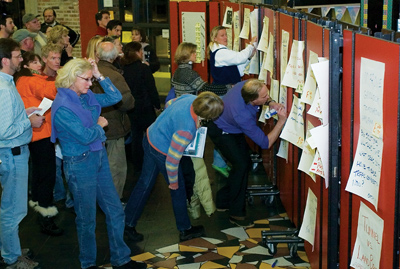
So last week we convened three small openings on the playground, in the playground. Actually turned out to be sort of little world cafe gatherings with flipchart pages taped to the walls of the building. We asked people to talk about the past, who they are, how they got here, and how the school got the way it is. We asked them to talk about future, what they imagined and dreamed the place might be in a year. And we asked about gifts and skills and lingering questions, about how they want this whole process to turn out.

We’re feeding the results back this week, online and on the school bulletin board. And offering to convene more sessions, so that the community conversation isn’t overwhelmed by modern day institutional colonization, albeit very well-intentioned.

My favorite moment of the process so far? One child coming off the playground on the way into school stopped at one of our posters. “What does that say?” he asked. “Conversation #3…” his mom began, “What gifts and skills do you have that can help create the place you want here? What do you have to contribute? What do you want to know?” It’s working already!

Neighborhood Resources Published


I had three pieces published in last week’s Chicago Sun-Times, all focused on “plugging into” neighborhood activities in Chicago:

Get active! …Many hands make fast work of solutions to challenges on your street

Community policing focuses on doing good …Faith-based groups will take the lead initiating good deeds in neighborhoods

Points of entry aplenty …Links to neighborhood organizations and connections citywide.

This was great learning to do just before our big move, to a new n’hood, next week. Good resources for my fellow Chicagoans, too. And if you’re not in Chicago, you might be surprised by what our police are up to. See second link above.

Inviting Digital Inclusion


Sascha Meinrath sez…

Through the hard work of folks like Michael Maranda and many others, the Chicago Digital Access Alliance has formulated an extraordinarily useful 10-point statement of principles applicable to every city engaged in expanding digital inclusion. Tackling the multi-faceted nature of the digital divide, the CDAA has drafted a document that should be brought before all decision-makers before they sign off on plans to wire(less) their communities. Congrats to the CDAA!

All Agreed! Read the 10-point statement

And my question for Michael Maranda… So when do we get to email this to the Mayor?

Inviting Aspen Again


aspen daily news

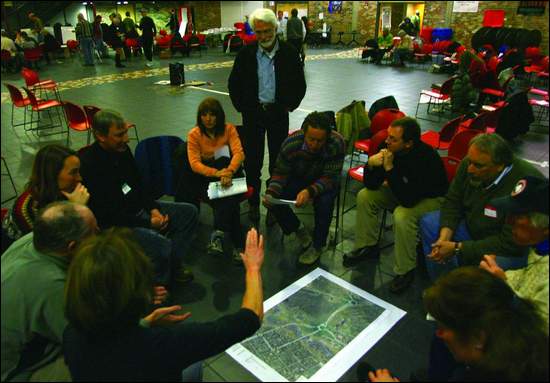
We did a second round of Open Space, 10am to 3pm, on the Entrance to Aspen on Saturday. Another 50 people showed up, reviewed the posters summarizing Wednesday’s conversations, posting another dozen or so issues. The focus was more squarely on asking the questions and bringing ideas that might “change the conversation” in the direction of resolution.

Where Wednesday had seemed to be focused on establishing positions, among perhaps a dozen or more different possible solutions, Saturday’s conversations were more about connecting and cross-pollinating. Several people remarked that they had changed their positions as a result of Saturday’s conversations. Skeptics from Wednesday offered that they were grateful and heartened by the quality of this second round.

Going forward, the City of Aspen will help keep the newly-spirited conversations going with a kit they call a ‘meeting in a box’ which will offer informtion, discussion questions, and citizen comment forms to anyone in town who would like to host a conversation on this 37-year-old question of what to do with the highway coming into Aspen. Then on April 12th, they’ll host and evening of keypad voting on questions that will be shaped by all this community conversing.

Saturday’s conversations were perhaps “less focused”, but that seems to be just what was needed for folks to soften their positions and start to listen and connect with others’ ideas and interests. After 26 ballot initiatives, this year might yet deliver real resolution to this question.

I worked with Claudia Haack on this one and together we wrote a nice set of finishing questions. These might be my new default set for closing circles. We asked participants to reflect on these things and then offer one short comment, maybe just one line, what might be their response to a friend asking “So what happened at that meeting, anyway?”

  • What was your experience here?
  • What are you taking away?
  • What did you learn? Any a-ha’s?
  • What was strange or different here?
  • How might you/we keep this going?
  • What new or next questions might make a difference now?

Meanwhile, I can also report that I skied all afternoon at Snowmass on Friday. Great snow, freezing cold (zero degrees, before counting the wind) outside, toasty warm in old hacker gear, no wrecks, but totally wore myself out. Some serious motivation for making body stronger this year.

Inviting Aspen


AspenOpenSpace1.jpg

This was the scene last night at the high school in Aspen, Colorado, in the first of two open space meetings to address a set of transportation issues that has generated 26 ballot initiatives in 37 years. This is the kind of space that you do the opening, unplug the microphone, and keep it with you, just in case. Participants posted 27 issues, which after combinations generated 18 working sessions. The Aspen Times (photo) and Aspen Daily News both had good things to say about our progess on their front pages this morning. We’ll have another round on Saturday.

In the meantime, today was my first time on skis in 10 or 12 years. Let’s just say that nobody skied the Greens at Buttermilk as hard as I did today! Hoping to make it a big Blues day tomorrow at Snowmass.

Inviting Digital Literacy


Michael Maranda is doing short interviews with people on the street, asking them what they know about the Chicago citywide wifi proposal, where they get their news, what they know about the internet, and how they use it.

This is all part of his work locally, statewide and nationally to cultivate digital literacy, otherwise known as bridging the digital divide. He’s organizing 77 community groups citywide to make sure that the citywide wifi contract will serve ALL of Chicago’s neighborhoods.

He’s posting the interviews at YouTube. I guess, in a few days, he’s going to post the one he filmed with me earlier this week — so go look now before that one posts! And Michael — I think your demographic sampling is a bit off!

Inviting Comfort


From the Christian Science Monitor…

Previous school shootings, notably the 1999 murders at Columbine High School, have led to calls for any number of useful, preventive measures, such as tighter security, more federal gun control, antibullying training for young children, more parental vigilance in communities, and closer screening of wayward students. And perhaps, as a result, many shootings have been prevented.

Those Old Order Amish who live a secluded life near the school at Nickel Mines, Pa., have a different idea. Their faith in the power of forgiveness led them to invite the widow of the nonAmish killer, Charles Carl Roberts IV, to the funeral for four of the slain girls. One Amish woman told a reporter, “It’s our Christian love to show to her we have not any grudges against her.”

This isn’t surprising. It is common for the Amish to invite car drivers who have killed one of their community members to the funeral. Such a compassionate response reveals a belief that each individual is responsible to counter violence by expressing comfort - a sort of prayer in action.

more…

Inviting Structures for Neighborhood Improvement


Mike Morin shares an interesting, practical, (and concise) neighborhood-based approach to rearranging our economic systems. He proposes a new structure, what he calls a Neighborhood Improvement Fund (a local sort of mutual fund), as the core of the shift. He favors equity unions over micro-lending arrangements, suggests a list of core operating principles (ideals), and outlines the basic structure and function of a Neighborhood Improvement Fund.

Inviting the Great Turning


Weekend of September 30th, David C. Korten, author, veteran, engaged citizen, speaks at various local places and times.

David Korten’s, When Corporations Rule the World, was one of the first books to articulate the destructive and oppressive nature of the global corporate economy. Now, ten years later, Korten shows that the problem runs deeper than corporate domination—with far greater consequences.

In The Great Turning, Korten argues that corporate consolidation of power is merely a contemporary manifestation of what he calls “Empire” — the organization of society by hierarchies of domination grounded in violent chauvinisms of race, gender, religion, nationality, language, and class. The result has been the same for 5,000 years, fortune for the few and misery for the many. Increasingly destructive of children, family, community, and nature, the way of Empire is leading to environmental and social collapse.

The Great Turning
makes the case that we humans are a choice-making species that at this defining moment faces both the opportunity and the imperative to choose our future as a conscious collective act.

via Nurul Eusufzai

Inviting Good Neighbors to Register


I met Cheryl Honey earlier this week at the international Transformative Mediation conference in Minnesota. She’s the creator of something called Community Weaving and the Family Support Network. Taken together they are a wildly ambitious — and effective — application of Asset-Based Community Development.

Cheryl and friends have created a site that allows anyone to register as a good neighbor and add skills, abilities, interests, experiences and other contributions to a national “resource treasury.” The treasury is searchable by geography, interest, skill, need, and many other ways — but only after you register.

I just registered myself in Chicago, and was able to find several others here to connect with. One of them is even listed as a facilitator of Open Space. I’d like to see the C3 leaders start registering here, too. There is a special designation for groups and we could use that for C3.