Doing Business in Open Space?


Corinne Nelson asked recently about how she and her husband might run their two-person business operations in an open space way. I rather enjoyed penning this answer…

I would say that it’s definitely possible to run and grow your business in open space, even with just the two of you. And, I’ll suggest that it might not *look* like open space to outside observers, i.e. there might not be a circle and facilitator and such. Or might there?

To see how this works, let what normally passes for open space technology, circle, invitation, marketplace, law of two feet and principles, bulletin board dissolve a bit. It’s enough, I think, if you each agree that you know some things, many of which can be listed explicitly, and don’t know many others about what might happen, most of which can’t even be named.

It’s enough, in practice, to list the things you know, about your needs, resources, interests, purposes, desires, and what might need to be done now about all of that. If there are open, unanswerable questions, probably they show up as ‘things to explore’, then list those too. Put the list of everything you know you want, think you have, guess you can or will do next, and might explore… all on individual post-it notes on a wall or poster or wherever is handy. Someplace that can stay visible and available for reference.

Then just have regular conversations in front of that board, as often as you find necessary, and whenever you don’t know what is happening or what to do next. The ‘question’, i think, that all these post-it note issues and topics and questions answers is this: What is this business and what should it be?

If you add new issues whenever you sit down together in front of this bulletin board, and keep notes every time you retire or resolve an issue… which might be through active development work, or might be when conditions change and some area posted for action or exploration just ‘falls off’ the wall… just make some notes, or don’t, but move it off to the ‘done’ pile.

As for involving clients or others, they need not be joining you in an ‘event’. They’re likely only needed for one or a few conversations. So ring them up when it’s time (whenever it starts is the right time) and chat about those few issues. They don’t need to know that they’re working in what you call open space. If you hire someone new, give them the pile of ‘done’ issues, perhaps some of which have notes on them. That is your training and orientation program, how we got here, from the beginning.

And this goes on, each of you and both of you sitting with, updating, reflecting, conversing, and resolving the issues on the post-its… until it’s over.

My business is just me, unless you count my wife as an advisory board, and this is how i’ve run my practice for many years, with the same ‘mind’ to my to-do list as I bring to any community bulletin board wall in any oepn space meeting.

In the end, it’s the mind we make, not the meetings. And when I get a chance to do a meetings with clients, it is really just sharing that mind and practice with them, even when they are several hundred people.

I might add here that even when I’ve worked inside of very large corporate organizations, this ‘mind’ and these practices have been effective — maybe even essential — for staying sane and getting things done.

Inviting Sales


Last September I ran into the people who make these cool (hot?) Sun Ovens. Turns out they have reps in Nepal, where I was set to do an Open Space training day in November. We made some connections and got the Nepali Sun Oven guys invited to come demo the ovens at the conference day, hoping that some of the community organizations attending would be good contacts.

The day of the event, I thought the Sun Oven guys spent most of the time out on the terrace, cooking up momos for the 40-50 people who came for the conference. Now they write to say that they haven’t heard back from any of the contacts they made on this day, but…

Everything is fine out here. It really snowed in kathmandu after 62 years yesterday, It was really cold, may be it was gift from the god as it was valentine’s day….Ha ha…
I really learned a great deal from the conference, me and my friend manish was there to attend the conference and we have used the open space technique in our office and it is really wonderful that we are comming out with wonderful ideas to boost up the sales of our products…especially the condom as you might not have yet known that i do the marketing of condoms imported from malaysia and also doing the marketing of Oxygen concentrators as well and i have been telling my friends about the conference and the open space techniques as well…

Yet another case of “whoever comes is the right people” … “whatever happens is the only thing that could have” …and “be prepared to be surprised.”

Inviting Aspen Again


aspen daily news

We did a second round of Open Space, 10am to 3pm, on the Entrance to Aspen on Saturday. Another 50 people showed up, reviewed the posters summarizing Wednesday’s conversations, posting another dozen or so issues. The focus was more squarely on asking the questions and bringing ideas that might “change the conversation” in the direction of resolution.

Where Wednesday had seemed to be focused on establishing positions, among perhaps a dozen or more different possible solutions, Saturday’s conversations were more about connecting and cross-pollinating. Several people remarked that they had changed their positions as a result of Saturday’s conversations. Skeptics from Wednesday offered that they were grateful and heartened by the quality of this second round.

Going forward, the City of Aspen will help keep the newly-spirited conversations going with a kit they call a ‘meeting in a box’ which will offer informtion, discussion questions, and citizen comment forms to anyone in town who would like to host a conversation on this 37-year-old question of what to do with the highway coming into Aspen. Then on April 12th, they’ll host and evening of keypad voting on questions that will be shaped by all this community conversing.

Saturday’s conversations were perhaps “less focused”, but that seems to be just what was needed for folks to soften their positions and start to listen and connect with others’ ideas and interests. After 26 ballot initiatives, this year might yet deliver real resolution to this question.

I worked with Claudia Haack on this one and together we wrote a nice set of finishing questions. These might be my new default set for closing circles. We asked participants to reflect on these things and then offer one short comment, maybe just one line, what might be their response to a friend asking “So what happened at that meeting, anyway?”

  • What was your experience here?
  • What are you taking away?
  • What did you learn? Any a-ha’s?
  • What was strange or different here?
  • How might you/we keep this going?
  • What new or next questions might make a difference now?

Meanwhile, I can also report that I skied all afternoon at Snowmass on Friday. Great snow, freezing cold (zero degrees, before counting the wind) outside, toasty warm in old hacker gear, no wrecks, but totally wore myself out. Some serious motivation for making body stronger this year.

Inviting Aspen


AspenOpenSpace1.jpg

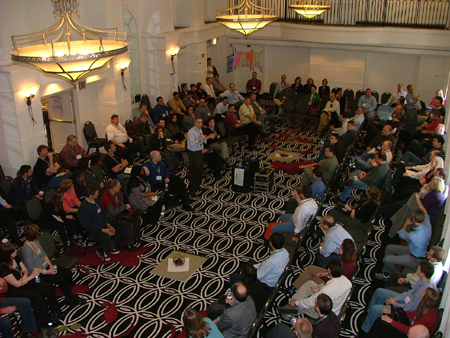
This was the scene last night at the high school in Aspen, Colorado, in the first of two open space meetings to address a set of transportation issues that has generated 26 ballot initiatives in 37 years. This is the kind of space that you do the opening, unplug the microphone, and keep it with you, just in case. Participants posted 27 issues, which after combinations generated 18 working sessions. The Aspen Times (photo) and Aspen Daily News both had good things to say about our progess on their front pages this morning. We’ll have another round on Saturday.

In the meantime, today was my first time on skis in 10 or 12 years. Let’s just say that nobody skied the Greens at Buttermilk as hard as I did today! Hoping to make it a big Blues day tomorrow at Snowmass.

Inviting Guide — Updated


I’ve just posted an updated edition of my Inviting Guide for the practice of Open Space Technology. This version makes some relatively minor refinements throughout, but also includes a new piece on writing the theme of an event.

If it weren’t for the long coaching conversation I had over lunch today, I might be worried that I’ve just about written myself out of a job. I think this new version is pretty good… AND I’m grateful there are still people around who would rather pay me to meet and eat and work with them than to wing it from the text. There’s more to practice than pixels!

Inviting the World We Want


Two years ago I worked with Phil Cubeta and some others to create something we called The Giving Conference. Since then, at least two Omidyar Network member conferences, something called Recent Changes Camp, staff meetings in Rio de Janeiro, and a bunch of other things have happened as results. Now there are conferences trying to happen in Thailand and Chicago.

Phil offered the following in the Thailand planning thread. This is why my facilitation of Open Space Technology is morphing into a larger practice of Inviting Leadership.

…the secret to a good open space is the invitation and also the invitation list. “Whoever comes are the right people,” but be sure to invite the right people. Go for broke would be my suggestion. Go for significant potential funders, political leaders, media, civic leaders, nonprofit professionals, thought leaders, moral leaders and religious leaders. Ask yourself who can convene these networks. Go to those “mavens” and enlist their support in not only emailing or writing the key people, but actively and personally inviting them.

The real work of open space is in networking networks together. That has to be done as the pre-work before the invitation goes out. In fact, the invitation will be drafted and redrafted, negotiated if you will, by each of the co-conveners as they insert phrases of important to their networks.

Michael Herman and I did this together three years ago for the Open Space on Giving. Our invitation was ultimately gibberish, because so many people pulled it in so many directions as a precondition of their inviting their networks. But the revision process led to their buy-in; and their personal invitation, not the words used, but their willingness to invite people over the phone, is what got the key players there. So treat the words as flypaper. Get key mavens stuck in the glue. The more they struggle with the the words the more involved they become, until the exact words no longer matter.

Phil and I worked by email two years ago, and lots of phone time. We traded 37 different drafts, many of them major revisions, of the invitation. We went round and round with words, but around a core purpose: Giving. And that is what’s been sustained and sustaining everything since then, that core purpose, in so many different languages. It’s just great to see so many ripples from something so simple as one short “invitation.”

Body, Soul, Spirit?


Doug asked me the other day about how I sort out body, soul and spirit. Here’s an answer I didn’t know I had until he asked:

in practical terms, i can find the edge of “me” that is my skin. everything inside is body.

then there is another layer, the energy of me. there are many layers, flexing and moving and shape-shifting all the time, but taken as a 3-D stack, they have a finite edge. everything inside of that edge is the space that i sense as “me” — and “mine.” i think of soul as this energy space, that extends sometimes quite far, and through time, and is ever changing its shape… but always i am making some story about how/why it is mine and what i think it should be or do.

beyond that edge, there is a wispier thing yet, a space that i find if i let attention follow the sound of the tingsha bells… and this space is bigger than my energy space, bigger than my story, boundless even. the bells are an invitation to relax into that, to relax the edges and efforts that are “me.” this space seems to be the ‘water’ we all swim in… and i’m inclinded to guess, swims through all of us, too. so this vast third space, all of stuff, all of space, all of awareness, all of everything beyond all of “me”, is what i think people are talking about when they say spirit.

sometimes we say, about open space meetings or other peak moments, that “spirit shows up”, i think that this means that some critical mass of people in the gropu, for some criticitacl mass of time in the event, relaxed their bodies and souls, their physical tissues and the stories and edges they each usually make around “me” and for some noticeable time, in some noticeable way, they were noticing that there is someting beyond those edges of “me” and noticing that they were all swimming in it, spirit, togetehr… so it’s not really spirit showing up… as them showing up and relaxing out into IT.

this might be another way to think about the gift of invitation, and open space. a chance to relax. “i’ve been invited,” we can think to ourselves, “they’ve asked me to join just as i am.” body rests just a little, on whatever ground we already have. story, and the efforts of mind that make it, rest a bit, too. we return from pushing to pulsing. breathe. now we can tap all of the vastness beyond our little isolated “me” selves, the whole soup of possibilities, in the direction of the next good thing.

maybe it’s only that we relax our little individual stories into the soul, the energy, the pulse of the organization, the spirit of the team, but even that is often quite something, to find and really feel the wave of organization, community, and fellowship carrying and supporting us as we go about our everyday work.

Inviting Leadership, Rediscovered


workshop-map

the festival i’ve been writing about comes right after my wedding and honeymoon. as i get back to work, doing and teaching inviting leadership, i can’t even remember the names of some of these practices that i’ve been working on and writing about for… how many years now? as one guy said to me, “now that’s a successful honeymoon.”

i purposely did not look up my last drafts on the practices so that i could discover them freshly, in the course of this new work. here is what i found myself doing as i opened space. more importantly, it’s what i found myself explaining in a short 1.5-hour workshop, without the luxury of a three-day retreat nor a depth of open space experience in the group:

  • opening heart (as the mainstream label and basic mechanism, and then) the practice work being about appreciating and embracing and such.
  • inviting attention - the practice work is about focusing and articulating and listening and sharing, vision and story.
  • supporting exchange - the practice work being about movement, connection, flow, conversation, marketplaces, gifts and offerings.
  • making good - on promise and promises, the practice being about taking actions and getting results that honor the care, invitations and support we’ve been given, and what of those we’ve pledged to others.

the image above comes from the morning workshop we did for leaders, on the last day of the festival. this latest language seems crude enough to travel, and still true enough to capture all the subtleties of deep practice. feels like progress.

The Power of the Pan


so now the story of our kitchen takeover at the festival. well, okay, so we didn’t exactly take the place over, we barged in 20 mins before the small cook staff was to serve 600 hot meals and they were kind enough to help us.

it was tuesday afternoon, three days into the festival, and we hadn’t met as a whole community since the opening saturday night. with so many concurrent activities, concerts, workshops, dances, and the like, the energy just kept getting higher and higher. there was no apparent way to ground it, and apply it in practical ways for ongoing connection, projects and everyday living. but how to rebel against a dominant culture and structure that might best be described as freedom and love?

we decided to take over the kitchen, even if quite peacefully and only for a few minutes. with the chef’s support, when she rang the dinner gong, we threw ourselves in front of small stampede of hungry people with empty bowls. we explained that soon we would ring a medium-sized roasting pan with a large wooden spoon and that would be their invitation to bring out their news - important stories and announcements that everyone should hear.

the purpose of the open space “track” of the festival was to connect the people and energy of the event with the rest of the world, to make some positive differences, to share the love in practical ways. so we went around the lawn explaining what we were about to do:

…if we want to change ourselves as individuals, we must concentrate our attention. and if we want the “bigger body” that is this festival community to change the world, we must concentrate our attention. in a few minutes we will ring the roasting pan and invite your attention in the center of the lawn. please join us for stories and news announcements…

if it sounds a bit dramatic, i suppose it was. changing the world can be like that. but it worked. when we rang the pan, people came in to listen. we used a small loudspeaker. a number of people announced projects and meetings and invitations, to cheers and applause. for a moment we were one, big, community circle, settling down and paying attention.

the next day, festival organizers discussed plans for including such all-community meetings into next year’s festival. we also discussed larger shifts toward much more open space, after what might fairly be called a rather timid first-run at it this year. we covered more ground this morning, in a workshop about leading in open space.

even it a much abbreviated form, the 40 or so breakout sessions that were posted did seem to result in some remarkable conversations. small groups that really dug into a wide range of issues and left many participants amazed and delighted at what showed up for them. but of course, this last bit is what we’ve come to expect in open space, timid first-run or not.

CatComm in Open Space


A few weeks ago, I had a couple of long Open Space coaching conversations with my friend Theresa Williamson, the founder of a successful and exciting community movement, called Catalytic Communities, in Brazil (Rio). Then she went off to try Open Space with her colleagues:

Every three months, CatComm’s staff spends a day away from the Casa or our home offices discussing accomplishments over the previous 3 months and new objectives for the following period. Thanks to a recent brainstorm with Michael we were able to experiment with Open Space for the first time. And the approach was overwhelmingly successful. The level of creative thought and exchange, and the sentiment of collaboration among staff, were all heightened. And I expect this to grow as we train and experiment in Open Space. What most surprised me was what the naturally positive approach inherent in Open Space taught me about how I had been handling things in the past…

…each staff member noted on a piece of paper a topic they wanted to moderate during the afternoon, with the intention of answering the question: “How do we make more good things happen at CatComm?”

In addition to focusing staff attention where staff were naturally interested, and on building on the positive in what we’re doing, Open Space also empowered staff to take control of the meeting. We will be incorporating Open Space into future open meetings held at the Casa with community leaders. Of course there topics will not be as imaginable as among staff with a clear common mission. As a result, we expect that implementing Open Space in open community meetings will result in exciting and unexpected collaborations and discussions.

As the director of CatComm I was refreshed to see staff taking control of the meeting… I was fascinated by the topics that came up naturally, as they are different to those I would have posed, but are perhaps closer to the pulse of what is really important…

Mostly, however, I was amazed to discover that in the past our staff focus has often been on the negative — “what have we not accomplished that we had planned to and why?” By asking the opposite question — “what have we accomplished and how can we do more of that?” — one arrives at the same answers, but through an empowering process rather than one that is disempowering.

Thanks for your work and your story, Theresa! This is just how it’s spozed to be! Now, just keep it going. It never has to get any more complicated than this — even when it’s really complex or conflicted. Just keep Opening!

Translating Open Space


Raffi Aftandelian and friends are translating on of my recent articles into Russian, for a collection. Not surprisingly, translating what we’ve called the “four practices of open space” and “inviting leadership” has been rather challenging. This from a proposed translator’s note seemed to have some merit on its own…

…there is a certain poetry in open space, a poetry that i have practiced capturing for almost ten years now in how i write. it means that words are often chosen for the specific reason that they mean many things at once. and like poetry, sometimes they are even chosen for the way they sound. so this makes translation very challenging, because these different meanings are intended to be read and heard and considered simultaneously, together. there is meaning in each interpretation and also some implication of having them both be true at the same time.

it is this holding of two states at once, distinct and together, that gives open space it’s texture and power. people are aware of themselves as individuals, and of the group as a whole. they are aware learning (taking in) and contributing (giving out), at the same time. open space is a dance of opposites, spirit and productivity. this is difficult to capture once in any language, and more challenging still to translate into another. in the end, we might say that open space is its own langauge, a language of movement, and the best way to really understand it is to do it. and be it. together.