How do we know if our practice is a real practice? Only by one thing: more and more, we just see the wonder. What is the wonder? I don’t know. We can’t know such things through thinking. But we always know it when it’s there.
–Charlotte Joko Beck

Michael Herman's Blog (2003-2016)
Inviting Agility in Challenging Environments
How do we know if our practice is a real practice? Only by one thing: more and more, we just see the wonder. What is the wonder? I don’t know. We can’t know such things through thinking. But we always know it when it’s there.
–Charlotte Joko Beck
I’ve written previously about the four essential practices of Open Space Technology:
When I first applied this view to my work, after 10 years of opening space, I found they made everything easier. I could do opening heart, during set-up. Then I could invite attention to start the meeting, and so on. One step, one task, one practice at a time.
In my latest facilitations, however, my learning progresses. I am finding that all I really need to do is the first practice, opening heart, and the rest happens almost automatically. This feels more like a river current carrying me and the rest of the event along.
I can see the other practices go by. I know that I’m doing them. And not doing them. At my best, they are becoming more like things that go by in a river, rather than goals or tasks I swim toward, accomplish, or do.
As I rest, relax, and open the space that we might normally refer to as heart, I find that the mental and physical state that arises leads naturally into the next thing, inviting attention. That attention allows supporting connections. Energy flows in and from the connecting and conversing, and automatically seeks ground in some tangible (real) action or product. And those actions and products, however large or small, become the foundation for deeper rest, relaxation and opening.
I find it easiest to start with heart and opening, but I suppose we can start anywhere, as long as we’re willing to be carried through all four seasons or dimensions of practice. If I can’t relax my heart, I can go back to past results, or back further, noticing whatever supporting connections I might have available. But more and more, it is the physical sensations of heart that tell me most clearly where I am, when is right, and what to do.
I’ll be gone on retreat for the next couple of weeks, resting in practice. Find me again here in March, or join us in April!
People sometimes ask me this question, usually because of my monk-like hairdo or some other Buddhist-like things I say and do. I always have a hard time answering. While some of my teachers are well-known Tibetans, what to say when they talk like this…
In Buddhism we have an incredible arrangement: universal education from beginning at birth up until death, as an old person. I feel these things could be put into a universal language. Give up religion, give up Buddhism. Go beyond the Buddhism. Essential aspect of the philosophy put into the scientific language. This I feel is my aim.
…about Essential Education? So, I don’t know if I’m a buddhist or not, but I care about awareness, education, practice, wisdom, and compassion.
Mark Frazier at OpenWorld reports this progress on what I would call micro-democracy:
…the Explorers Foundation of Denver announced that its Cobden-Bright Award will help fund Openworld’s development of a new “Grassroots Land Registry” web site, whose aim is to pilot a new strategy for awakening dormant capital in poor communities.
Highlights of the strategy are described in the full text of the announcement below. In brief, the approach we are gearing up to demonstrate hinges upon creating new incentives for residents of neighborhoods to work together on resolving ownership disputes and creating private land registries.
The project will reward residents in pilot project areas who agree to a “good neighbor” covenant for arbitrating disputes, and who upload photos and brief video affirmations of uncontested property claims to an Openworld web site. Households in areas that take such actions will gain access to microscholarships for eLearning and microvouchers for health care resources.
Go, Mark! Go!
James Rehm’s review of Michael Strong’s book on Socratic practice makes me want to be a teacher.
“Socratic questioning,” writes Strong, “is an endlessly sophisticated art. It is the engine that drives Western thought forward. Socratic questioning is not a technique, it is an approach to conceptual understanding which contains within it an intrinsic craving for conceptual refinement at every level of understanding.” (p. 149).
…A good argument can be made, he says, that introductory science courses would teach more if they offered students an immersion in scientific method and thinking rather than flooding them with a sea of information. In the same way, Strong – who likes math and is good at it – believes that Socratic practice should be a prerequisite for all math education. Why? Socratic practice, whether it traffics in discussions of trust, love and betrayal or other ideas equally remote from square roots and tangents, improves students’ facility with abstract concepts, and abstract concepts are the basis of mathematics, which is at root a way of thinking rather than a body of knowledge.
In reading the whole of this review, I notice that I have some deep inner valuing of teaching and learning. They are self-inviting, self-satisfying, self-sustaining. The more I teach or learn, the more I want to teach and learn. And in Socratic practice these two seem to run together, as the flow of Awareness. Why stop with the humanities, math, and science? Why not paint all of our work with this care?
Strong’s book, The Habit of Thought: From Socratic Seminars to Socratic Practice is available at New View Publications.
I-GO, Chicago’s non-profit car-share program, has a new blog to talk about environmental issues in Chicago. The blog looks pretty cool and the car share program makes access to a car affordable while reducing the numbers of cars off the road.
A “No” uttered from deepest conviction is better and greater than a “Yes” merely uttered to please, or what is worse, to avoid trouble. – Mahatma Gandhi
I invented something last week at Recent Changes Camp. An adaptation of a WordPress weblog. A question came up about how to attach a sort of “toolkit” to articles about people doing good in community, to help others connect and support more good.
Here’s my hacker solution: A WordPress weblog that would allow open registration and then direct posting by readers of these articles. Titles of posts would name the issue. The body of the post could include any sort of contact info and clarification of interest.
A small set of categories would allow people to tag themselves with levels of interest and action: give money, give time, give stuff, refer others, make links, talk by phone, email, meet to discuss, host a conversation, learn more, teach skills, partner on project.
With a little skilled software tweaking for easier user access, it seems that this system could be quite a nice little marketplace for readers, writers, givers and activists. Anybody could search for the issues and interests they were looking for. I’m posting it here in case somebody out there already has a use for it. Might be a next generation of SmallChangeNews.
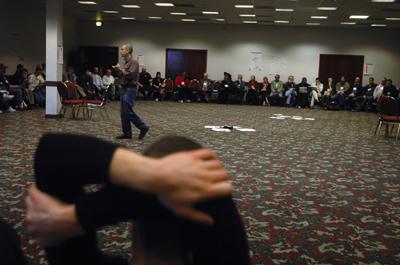
Recent Changes Camp made news in Portland this past weekend, combining software and community development. The Oregonian ran these photos and a good article as well…
…some wondered aloud whether it would descend into chaos — or into some kind of hippie technology fest. “I really had no idea what to expect. I didn’t know whether there would be people with no shoes on and caftans or what,” said Mike Cannon-Brookes, chief executive of a Sydney-based company called Atlassian Software Systems, which designs wiki software.
A couple of people did come in sandals, and many wore jeans, but no one was burning incense. And once the meeting broke up into a dozen discussion groups, it suddenly seemed focused and orderly.
Good News Network founder Geri Weis-Corbley captured a great on-the-fly open frame movie of the event as well.
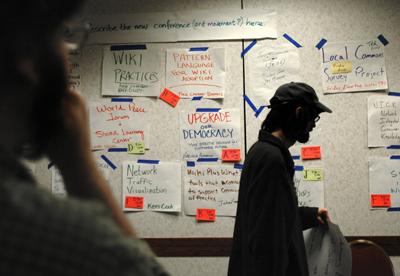
Remember the American Revolution? When the people rose up and made government respond to their needs and interests? Seems a new revolution may be emerging in the state of Washington. It’s called Easy Citizen Involvement.
I met Dick Spady, the leader of the revolution, at RecentChangesCamp last week. He’s working to create something called Citizen Councilors in Washington state. Last year he ran a legislative initiative. This year he’ll collect 200,000+ signatures on petitions, to take it directly to the people, on a statewide ballot.
His plan works like this: Once approved by the people of the state, they will gather $10,000 in donations. That achieved, they’ll set up an 800 number to collect 1000 subscriptions for $10 each. Subscribers will commit to convening conversations of 8-12 neighbors and friends. Others will sign-up as communicators, to download and print materials for their groups.
While they are gathering subscribers, volunteers and elected officials will work with the State Auditor to produce a set of opinion survey questions that will form the basis for small group conversations throughout the state. After the conversations, participants will answer the survey questions and submit to the State Auditor for statewide tabulation.
It’s a revolutionary invitation to community conversation and feedback mechanism for federal, state and local governing officials. The Washington Association of Churches is supporting the petition and ballot initiative, giving it a good chance at succeeding.
See also, Dick’s State-of-the-Union Project, which invites and supports similar dialogue programs in schools, using the State of the Union address as the basis for students expressing their own opinions and listening to the opinions of others. It’s up and running and ready for classroom use.
I lunched at RecentChangesCamp with Jon Ramer and Jair. Our storytelling is well summed by this bit from Jair’s site:
You have — within you — the fuel to thrive and to flourish, and to leave this world in better shape than you found it. Sometimes you tap into this fuel – other times you don’t. But the sad fact is that most people have no idea how to tap into this fuel or even recognize it when they do. Where is this fuel within you? You tap into it whenever you feel energized and excited by new ideas. You tap into it whenever you feel at one with your surroundings, at peace. You tap into it whenever you feel playful, creative, or silly. You tap into it whenever you feel your soul stirred by the sheer beauty of existence. You tap into it whenever you feel connected to others and loved. In short, you tap into it whenever positive emotions resonate within you. — Barbara Fredrickson, Positive Emotions & Psychophysiology Laboratory @ University of Michigan
Jon mentioned some conversations he’s been having with others about “Unimagined Capacity.” He tells remarkable stories of people discovering this unimagined power. It seems to me that we need more conversations about this. When was the last time you discovered some unimagined capacity in yourself or your people?
can you join us on bainbridge island, off seattle, on thursday, february 9th? the theme of the day is practice. so far, we are expecting about 15 people for a full day of learning and connecting.
i’ve been thinking lately about open space practice in terms of opening heart, inviting attention, supporting connection, and grounding the energy. i offer that as some slim subtext. anything that falls into one or all of those buckets is fair game and the rest of the plan is all open space.
email if you’d like to join us. we’re doing a simple, potluck and pizzas sort of lunch.
Friends and colleagues in Nepal, people I’ve worked with for the last several years in my travels there, opening space for peaceful development, send this report this morning, following Maoist attack(s) last week:
…Ram Bdr. Raut (national chairman of the NAINN peaceful development community) and his family was hardly survived due to heavy bombardment of Night vision helicopter and two way gun firing. One of the bumps was dropped very close just 8-10 meter away caused a serious damage in the house and all the glasses of windows and cupboards, kitchen utensils and the doors are smashed. Some parts of walls are cracked and hundreds of holes due to gun bullets. He and his family were hiding in the toilets of ground floor and they are hardly survived. Still his wife and children are mentally depressed and remain silence. Same thing was happen to other people of Palpa. Right now, there is no email and Internet for communication and telephone is partly working in the city. For your kind information, I am giving brief status of present Palpa according to sources of news media, Ram Bdr. Raut and other NAINN members.
1. According to civilian witness, 5000 Maoist attacked the Palpa District Headquarter.
2. Almost government buildings are completely collapsed including 23 civilian houses and gun bullets damage many other houses. For instance, District Administration (150 years old palace), District Development, District Auditing and Fund Control, Land Control, National Intelligence, District Scout, District Telecommunication, District Officers’ Club, District Jail, District Police and other police post and security guard offices and Paschimanchal FM Radio Station has destroyed.
3. Loss of civilian houses and government buildings and properties is still unknown.
4. Government claimed 34-security force and government officials have kicknapped including Chief District Officer but Maoist declared only 29 are in their controlled.
5. In the attacked, 11-security force, 6 Maoist and two civilians were killed and 25-security force is injured.
6. 136 people are freed from the District jail including five Maoist by Maoist.The Tansen town (Palpa District Headquarter) has remained as a relic of war. People of town is still couldn’t sleep from seeing the battle. In this regard, please help us (NAINN) from CWRU to work hard to create positive pressure for government of Nepal and Maoist insurgents for peace dialogue and seize fire. I also request you to help to create positive pressure from international communities for government of Nepal and Maoist insurgents for the seize fire through peace dialogue. We realized, this is the high time to save the life and property of Nepal.
News like this gives new perspective to issues like “Upgrade Our Democracy” and “Create the New Philanthropy” being raised here at RecentChangesCamp. What should we be learning from Nepal this morning?